False Claims and Stolen Bylines: Russia's Propaganda Tactics Haunting Newsrooms
The Rise of Journalist Impersonation in Disinformation Campaigns
Falsified claims, fabricated quotes, and inaccurate reporting can severely damage a journalist's credibility and even threaten their career. But what happens when a journalist finds their name and photo on a story they never wrote? This is becoming an increasingly common occurrence, particularly as part of campaigns orchestrated by pro-Russian disinformation actors.
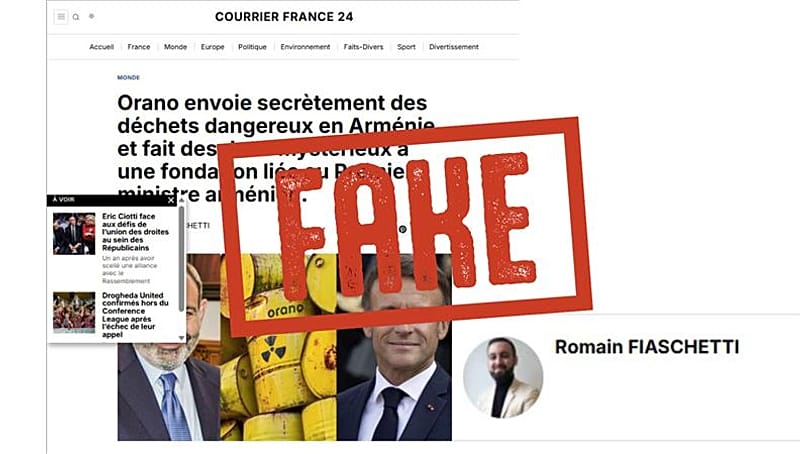
One such campaign is the Storm-1516 operation, which spreads false narratives about Ukraine and the West online. These efforts often involve impersonating legitimate news outlets and stealing journalists' bylines. This form of digital identity theft has affected many professionals, including Romain Fiaschetti, an entertainment reporter from the south of France.
In June, Fiaschetti received an unexpected Facebook request from a Paris-based gynaecologist, who asked if he had published an article alleging that Orano, a French nuclear waste company, was secretly bribing Armenian officials to take on France’s waste. Upon checking the link, Fiaschetti discovered his name and headshot on the story’s byline — despite never writing it.
The article claimed that Orano had started shipping toxic waste to Armenia in June after wiring money to a foundation fronted by Anna Hakobyan, the wife of Armenian Prime Minister Nikol Pachinian. However, these allegations are false: French law prohibits the transfer of waste to foreign countries, and both Armenian authorities and Orano have denied the claims.
The piece was published on the now-suspended CourrierFrance24 website. Although its exact origin is unclear, the claims were relayed by Azerbaijani media and a string of pro-Russian social media accounts linked to Storm-1516. Publishing articles on fake news outlets like CourrierFrance24 is part of a calculated strategy to plant bombshell revelations amid legitimate-looking stories.
These outlets also feign credibility by using names similar to reputable news organizations. For example, CourrierFrance24 combines "Courrier International," a publication that translates and publishes excerpts from international newspapers, with "France 24," the international arm of France’s public broadcaster.
"I saw my name and my headshot on the story's byline, except I never wrote it," Fiaschetti told Euronews’ verification team, The Cube. "The original site had five or six pages of articles bearing my name. Two of my colleagues’ bylines were also impersonated."
In the days that followed, Fiaschetti began receiving messages from Azerbaijani journalists who congratulated him for what they branded as an "excellent investigation." He felt scared and put out social media disclaimers to alert people that he didn’t write the piece. He also filed a complaint with the police for identity theft, but he isn’t sure if it led anywhere.
'Manual and Deliberate' Disinformation Techniques
Experts suggest that the disinformation techniques used by pro-Russian actors are less complex than people might think. Guillaume Kuster, founder of CheckFirst, a Finnish software and methodologies company that tracks disinformation, said that most of these operations are manual and resemble PR firm strategies.
"There are tools that allow you to create AI-generated voices for around $10 or $12 per month," Kuster said. "It's not as intricate as people think."
Another journalist who found herself targeted was Helen Brown, a freelance arts reporter who writes for publications like The Telegraph. She was shocked when she received a message on X from an AFP fact-checking journalist, who shared a link to a story claiming that an employee from Ukraine’s Anti-Corruption Bureau had fled to Europe with evidence of President Volodymyr Zelenskyy’s supposed involvement in a €1.2 billion luxury property embezzlement scheme.
The story was published on a website called the "London Telegraph" and attributed to a journalist named "Charlotte Davies." Next to Davies' name was Helen Brown’s headshot — much to her horror.
"I feel that as a journalist you have to put your profile out there, but as much as sharing my photograph and identity online gives me credibility, I realized that it can also be manipulated to create a false identity," Brown said in an interview.
Targeting Those Who Fight Disinformation
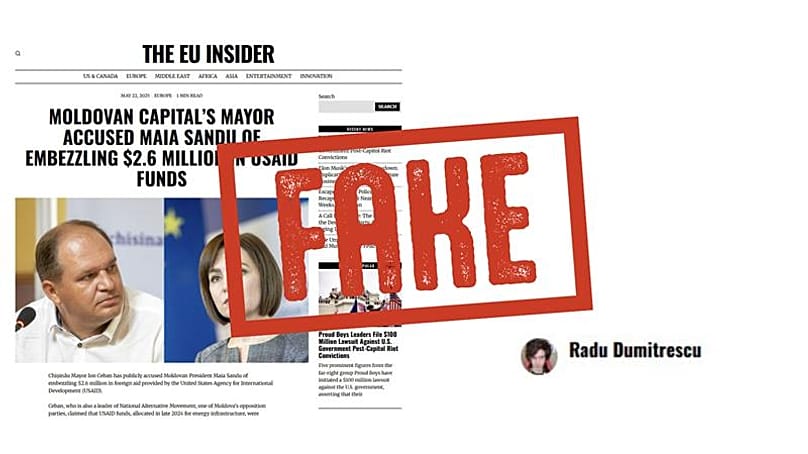
In some cases, those who directly work to combat the spread of pro-Russian disinformation become the prime targets of identity theft. Radu Dumitrescu, a Romanian journalist covering politics, including electoral interference in Romania and Moldova, was surprised to find his name attached to a story about the very kind of propaganda he works to untangle.
Bearing his byline, the story published in May peddled the false allegation that Maia Sandu embezzled $2.6 million in USAID funds. This fits into a long list of corruption claims that targeted Sandu ahead of the Moldovan elections in September.
"I know these things happen, but you never expect it to happen to you," Dumitrescu told The Cube. "I don't consider myself such an important major voice in the Romanian landscape, but maybe that's part of the reason why I was chosen."
Flipping Narratives and Legal Challenges
This propaganda tactic of flipping or switching the narrative is a recurring one. For example, Benoit Viktine, former Moscow correspondent for French newspaper Le Monde, discovered his name on an article claiming that France’s President Emmanuel Macron had spent a fortune on a luxury war bunker in a bid to prepare for World War III. The piece was published on a website named "brutinfo[.]fr" — a name that imitates the real French news outlet "Brut."
Although Viktine has never written any such story about Macron, he has previously reported on the bunker Putin sought refuge in during the COVID-19 pandemic.
For Kuster, it is important that journalists and media outlets take action when their identities are taken or impersonated. "Journalists should notify the platforms that their name or their organisation's name was unduly used," he said. "A lot of journalists think, who are we even fighting against?"
However, the EU Digital Services Act mandates that platforms have notice and action procedures in place. These measures are tools that exist to try and slow down these propaganda actions.