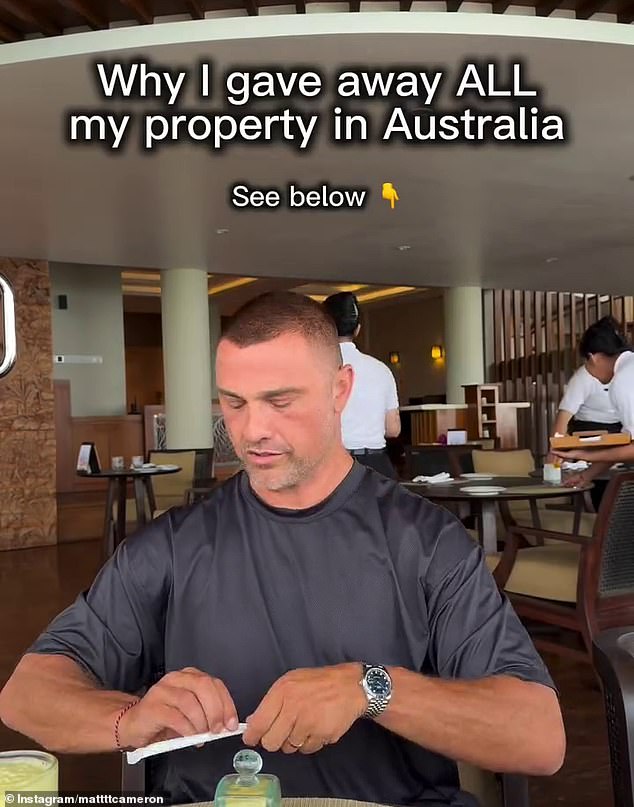
I Sold All My Australian Properties – Here’s Why You Should Too
The Decline of the 'Aussie Dream' and the Rise of Overseas Investments
Entrepreneur Matt Cameron, known for his bold decisions and lifestyle changes, has recently made headlines by selling all his properties in Australia. He claims that the so-called "Aussie dream" of property wealth is no longer viable and has encouraged others to consider investing elsewhere.
Cameron, 46, who once had a multimillion-dollar property portfolio in Sydney, now resides in Bali with his family. He attributes his decision to leave Australia to a combination of high taxes, excessive regulations, and poor returns on investments. According to him, the Australian property market is not as profitable as it once was, and the costs associated with buying, holding, and selling property have eroded any potential profits.
The Hidden Costs of Property Investment in Australia
Cameron emphasized that the hidden costs and aggressive tax systems in Australia have made it difficult for investors to make a profit. He pointed out that when all the taxes, charges, and fees are factored in, the returns on property investments are minimal—often just three to four percent. This, he argues, is not enough to keep up with inflation.
He also criticized the way property developers market their projects, highlighting that they often focus on capital appreciation and headline returns while ignoring the high interest rates that investors must pay on loans. For example, borrowing $1 million and paying back $2 million in interest can make even a seemingly profitable investment seem like a loss.
The Final Straw: Delays and Poor Returns
One of the key reasons Cameron decided to sell his properties was the delay in the completion of an off-the-plan property. What was supposed to take 18 months ended up taking over three years, leading to a significant loss of value. Instead of finalizing the settlement, he chose to walk away from the project, believing that it was a smarter decision than holding onto a declining asset.
The Flaws in the Australian Market
Cameron identified several major flaws in the Australian property market, including poor returns, inflated costs, and one of the most aggressive tax systems globally. He believes that the market is still clinging to the 1990s dream of property wealth, while other countries have moved on.
According to him, overseas markets such as Indonesia, Singapore, Dubai, and even the United States offer higher returns, lower taxes, and more favorable conditions for foreign investors. He claims that he can achieve returns of 15 to 25 percent offshore with half the stress and in half the time compared to investing in Australia.
Why 'the Smart Money' Has Left Australia
Cameron insists that he is not alone in his decision to move his investments overseas. He claims that a wave of wealthy Australians is leaving the country, attracted by better opportunities and more favorable conditions abroad.
He argues that Australia is one of the highest taxed and most over-regulated countries in the world, making it difficult for investors to build real generational wealth. In contrast, other nations are actively competing for foreign investment, offering better returns and fewer restrictions.
Investing in Bali: A New Frontier
For now, Cameron has focused his efforts on Bali, where he claims the market offers better returns, faster processes, and fewer restrictions. He highlights that construction costs in Bali are significantly lower than in Sydney, allowing investors to build luxury villas without the same level of overhead.
Bali, he says, is set up to support foreign investment, with lower taxes, faster approvals, and a more streamlined process. He also points out that the island has a high Airbnb occupancy rate, with tourism growing at around 15% per year.
A Business Approach to Investment
Cameron advises investors to treat overseas property investments like a business rather than a gamble. He emphasizes the importance of following formal procedures and using the right legal structures to protect their interests.
He explained that property transactions in Bali are handled by Notaries—government-appointed officials who ensure both parties are protected. He warns against falling for common pitfalls, such as transferring money to strangers without proper documentation.
A Philosophical Shift
Cameron's decision to move to Bali is not just financial; it is also philosophical. He rejects the idea that he is simply chasing a tax break, instead calling it "tax minimisation." He argues that everyone would want to pay less tax, especially when the government does not seem to know how to spend it effectively.
He also points out that the quality of life in Bali rivals that of some of the wealthiest individuals in Australia. By relocating, he has been able to outsource tasks and spend more time with his family.
The Future of the Australian Dream
Ultimately, Cameron believes that most Australians have been misled about property being the safest way to build wealth. He argues that the high interest rates charged by banks mean that borrowers often end up paying back more than the loan amount.
As for whether he will ever return to the Australian property market, his answer is clear: "I will never invest in Australia again. The Aussie system is set to manipulate and rob people at every turn."