Reeves' Credibility Under Fire as Markets Slam UK Post-Tax U-Turn
Rachel Reeves Faces a Credibility Crisis Amid U-Turn on Income Tax
Rachel Reeves, the UK Chancellor, is currently grappling with a credibility crisis following her dramatic reversal on hiking income tax in the Budget. The unexpected shift has sent shockwaves through financial markets, with investors piling on risk premiums to UK government borrowing. This move came despite weeks of hints and strong rhetoric from the Treasury.
There are growing concerns that another attempt to "whack" businesses and extract more money from the wealthy could undermine confidence and lead to more severe issues. The U-turn followed an open revolt within Labour against breaking the election manifesto, prompting No10 to panic about Keir Starmer's survival.
Government sources claim the change was due to slightly less bleak forecasts from the Office for Budget Responsibility (OBR), with stronger wage revenues partially offsetting a grim productivity downgrade. However, this adjustment still leaves a £20 billion deterioration in the fiscal position.
The Institute for Fiscal Studies (IFS) suggested that Ms. Reeves might have "talked up" the income tax increase to temporarily drive down gilts yields, improving the backdrop for her Budget. Despite this, she still needs to close a fiscal gap of up to £40 billion by November 26, as she has committed to rebuilding "headroom" wiped out by jettisoning policies like benefits cuts.
Economists are alarmed that she may now look at a "Smorgasbord" of smaller tax increases to bail herself out of trouble. These could include a new gambling levy, higher taxes on expensive properties, and per-mile charges for electric vehicles. Extending the hated "stealth raid" freeze on tax thresholds for another two years could raise billions by dragging millions into the system.
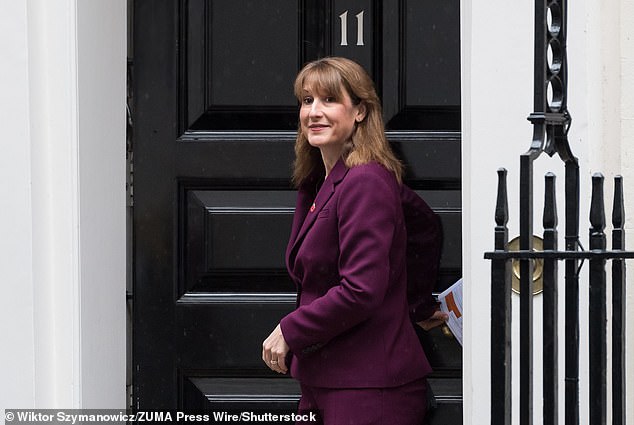
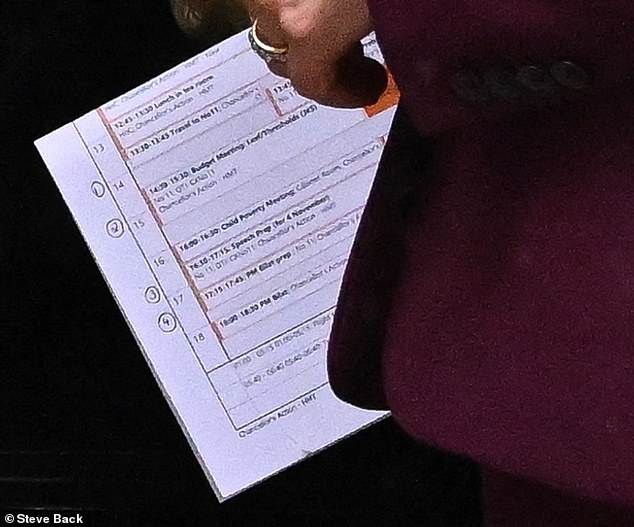
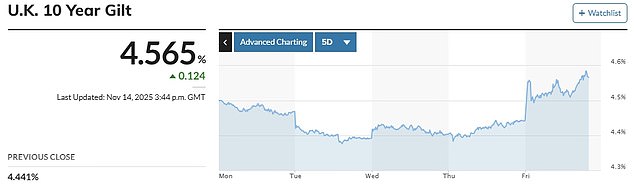
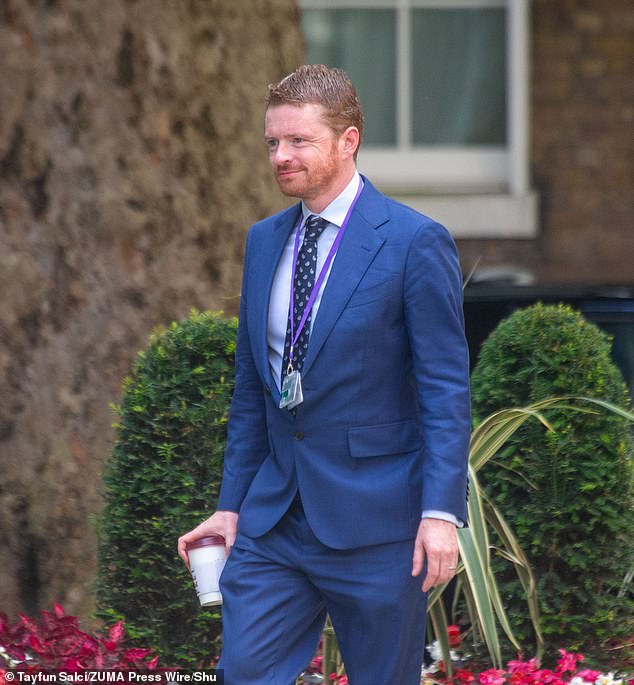
Labour insiders are in despair over the shambolic briefing ahead of the critical package, with blame being cast on Treasury minister Torsten Bell and No10 chief of staff Morgan McSweeney. Interest rates on gilts spiked in early trading, though they fell back slightly after the Treasury issued a statement emphasizing the Chancellor’s determination to shore up public finances.
Analysts warned that the UK could be facing a "credibility shock" after the infighting and public contradictions. Even Labour's favored think-tank branded the situation "not normal." Ms. Reeves' shift in approach appears to coincide with panic in Downing Street over the threat to Sir Keir.
Only last week, the Chancellor delivered a highly unusual pre-Budget speech warning that "everyone" would have to "contribute" to shoring up the government's books. She then stated publicly that cutting capital spending would be the only way to abide by the manifesto promises. That was universally seen as confirmation of broad-based tax increases.
Nigel Green, CEO of global financial advisory deVere Group, warned that "mixed signals" were spooking the markets. He said, "This is exactly how credibility shocks begin. Gilts are sliding, borrowing costs are climbing, and sterling is weakening because markets fear the government is improvising."
The Resolution Foundation think-tank, often favored by Labour ministers, warned that the briefing risked damaging the country. Chief executive Ruth Curtice said, "It is normal for economic forecasts and policies to change in the run-up to the Budget. It is not normal for so much of that to be laid bare in public."
Economist and crossbench peer Lord Jim O'Neill told BBC Radio 4's World at One: "I'm a bit surprised and confused... It is pretty hard to escape the conclusion that the change of mindset is being done because of the divisions inside the Labour Party."
One despairing government official told the Daily Mail of the turbulent Treasury process: "Ironic that this is the one where they introduced the idea of a Budget Board with Torsten in the chair to make the whole thing more orderly and consultative."
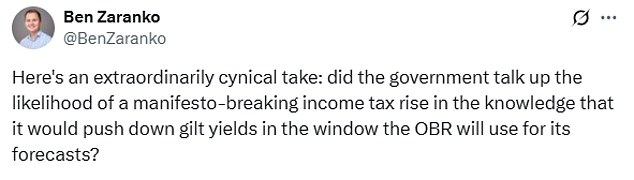
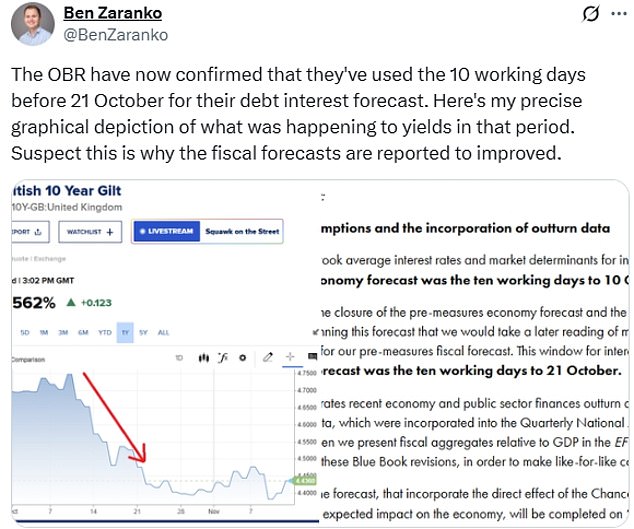
Ben Zaranko, an economist with the IFS think-tank, said, "Here's an extraordinarily cynical take: did the government talk up the likelihood of a manifesto-breaking income tax rise in the knowledge that it would push down gilt yields in the window the OBR will use for its forecasts?"
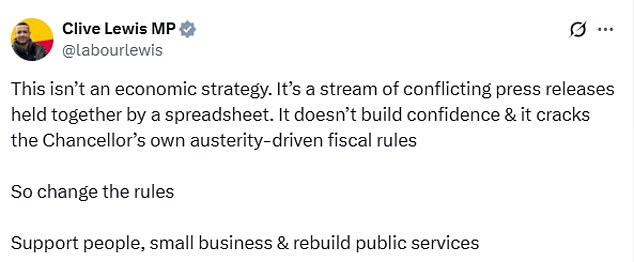
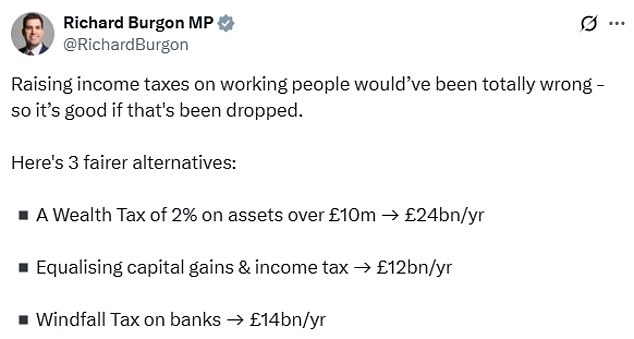
Left-wing MPs have hailed the abandonment of the income tax hike and renewed calls for a 'wealth tax'. Appearing on LBC Radio this morning, Mr. Streeting also welcomed the U-turn. "I'm not in favour of breaking manifesto pledges," he said.
Grim figures released on Tuesday also revealed that unemployment had hit the highest level in more than four years, potentially giving Ms. Reeves more pause for thought. And there was more evidence of an economic slowdown yesterday, with GDP essentially flatlining in the third quarter.
Ms. Reeves is expected to take what has been dubbed a 'smorgasbord' approach – tinkering around the edges of the tax code to milk more money from workers and the better-off. The Cabinet is said to be so deeply divided on what to do that Ms. Reeves had written two Budgets, one openly breaking the manifesto and another skirting round the edges of it.
A Treasury spokesman said: "We do not comment on speculation around changes to tax outside of fiscal events. The Chancellor will deliver a Budget that takes the fair choices to build strong foundations to secure Britain's future."
Julian Jessop of the IEA think-tank has estimated that significant reductions in tax thresholds would be needed to raise the same amount as a 1p increase in the basic rate of tax - £8 billion. The threshold for the higher rate could have to fall from £50,270 to about £46,000, and the top rate from £125,000 to £100,000. Calculations by the Daily Mail indicate someone on £50,000 would face paying around £750 more tax a year.
