How Hotter Is the World Since Paris? A Decade of Data Revealed
A Decade of Climate Change: The Paris Agreement and Its Legacy
In 2015, nearly 200 countries came together to sign a landmark agreement aimed at addressing the growing threat of climate change. The Paris Agreement set an ambitious goal: to keep the rise in global average temperature "well below 2°C above pre-industrial levels" while striving to limit it to 1.5°C. This historic pact was seen as a turning point in the global fight against climate change.
However, a decade later, the world has experienced significant changes. As leaders prepare for COP30, UN Secretary General António Guterres acknowledged that a temporary overshoot above 1.5°C, starting as early as the 2030s, is now inevitable. Despite efforts to curb emissions, global temperatures have continued to rise, leading to more frequent and intense extreme weather events.
The Warmest 10 Years on Record
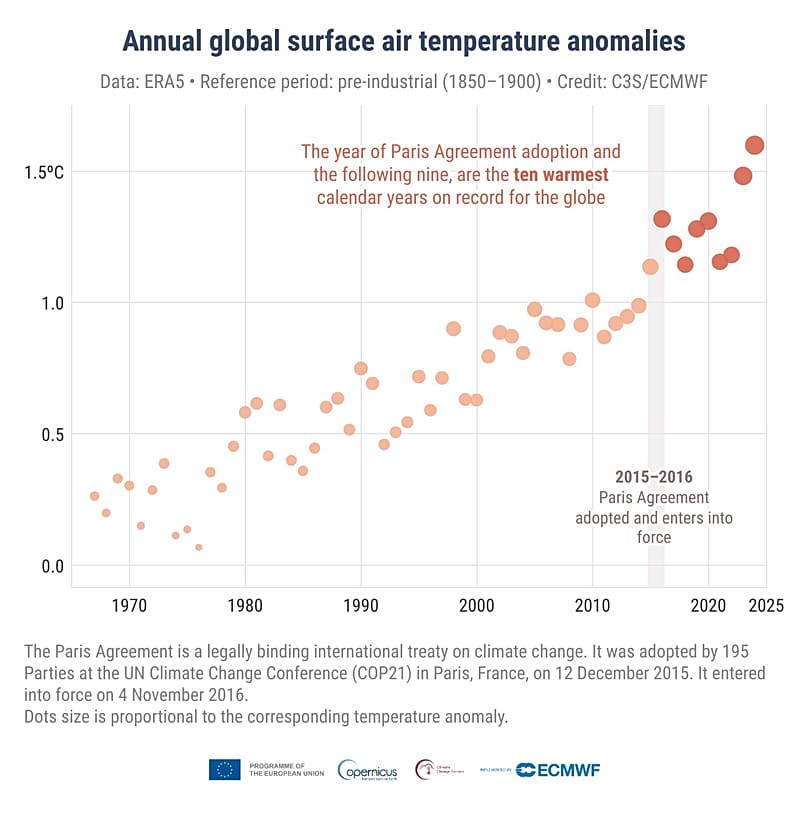
The Copernicus Climate Change Service (C3S) and Copernicus Atmosphere Monitoring Service (CAMS) have compiled data showing the dramatic shifts in climate and atmospheric conditions over the past decade. From 2015 to 2024, these years have been the warmest on record. Depending on global temperatures in November and December, 2025 could be either the second or third warmest year ever recorded.
Carlo Buontempo, director of C3S, noted that "every year since [the Paris Agreement] has ranked among the 10 warmest on record." He emphasized that the climate is shifting at a pace never seen before by humanity. For the first time, it's possible that the 1.5°C threshold will be exceeded for three consecutive years.
How Close Are We to 1.5°C?
In December 2015, during the signing of the Paris Agreement, data estimated that global warming had reached 1.04°C above pre-industrial levels. It was projected that the 1.5°C threshold would be reached by March 2042. However, based on data from September 2025, the current level is 1.4°C above pre-industrial levels, with the 1.5°C threshold potentially reached around 2029.
This means that a decade ago, the deadline for reaching 1.5°C was 27 years away. Now, it’s estimated to be just four years away, a significant shift in the timeline. Experts suggest that global warming has accelerated rapidly in recent years, driven largely by increasing concentrations of greenhouse gases in the atmosphere.
Progress and Challenges
Despite the challenges, some progress has been made. In 2015, the UN Environment Programme’s emissions gap report projected a baseline of around 4°C of warming by 2100. The latest emissions gap report indicates that the world is now heading for 2.8°C warming if current policies are implemented, and between 2.3 and 2.5°C if the Paris Agreement’s national climate plans are fully realized.
However, emissions have continued to rise. Greenhouse gas concentrations have steadily increased since 2015, reaching record highs in 2024. According to the World Meteorological Organisation, this was the largest one-year increase since measurements began in 1957.
Carbon dioxide concentrations in the atmosphere have increased by 5.51% since 2015, reaching 422 parts per million (ppm) in December 2024. Methane concentrations have also risen by 4.86%, reaching 1,897 parts per billion (ppb) in the same period.
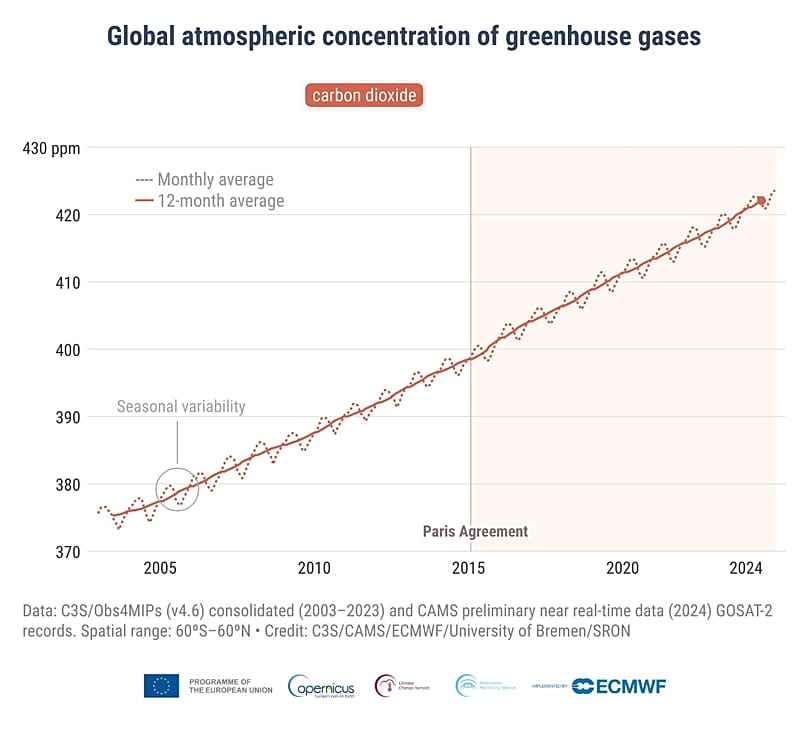
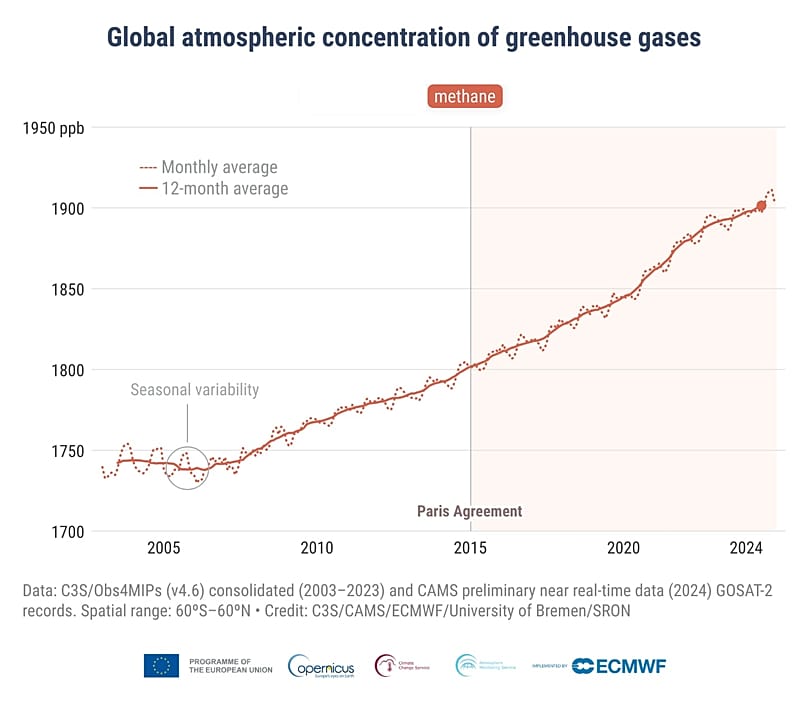
Laurence Rouil, director of the Copernicus Atmosphere Monitoring Service, highlighted that "from air pollutants to greenhouse gas concentrations, our atmosphere is perhaps the most direct and immediate indicator of every action we take." She noted that CO2 concentrations have risen over 5%, reaching their highest annual levels ever recorded.
Fossil fuel emissions accounted for almost 75% of total carbon emissions in 2024, but wildfires also released more than 1,300 megatonnes of carbon in 2025, contributing to poor air quality and health issues.
Extreme Heat Becomes More Common
Extreme heat has become more likely since 2015, according to a joint report from Climate Central and World Weather Attribution. On average, countries have experienced 11 more hot days per year over the past decade compared to the previous decade.
The report analyzed extreme heat events from each of the six major continents as case studies. Three of the six heatwave events studied would have been nearly impossible without climate change, including the record-breaking 2023 heatwave in Southern Europe. Two events were around 10 times more likely to occur in 2025 than in 2015.
A weeklong heatwave like the one in Southern Europe in 2023 is now 70% more likely and 0.6°C hotter than it would have been a decade ago. These events were nearly impossible in a pre-industrial climate, highlighting the urgent need for action.
