Interactive Map Shows Longest Commutes Worldwide – How Does Yours Stack Up?
Understanding Daily Travel Time Around the World
Whether it's on the bus, in the car, or on foot, the daily commute is something that many people dread. But how does your travel time compare to others around the globe? A recent study led by the Universitat Autònoma de Barcelona (ICTA–UAB) and McGill University in Canada has provided some fascinating insights.
The researchers analyzed the personal and work-related travel of people living in 43 countries, representing more than half the world’s population. Their findings revealed that the average person travels for 1 hour and 8 minutes per day, regardless of the mode of transport or their economic status. This consistent figure highlights a universal pattern in how people allocate their time for travel.
Global Travel Time Comparison
In terms of specific countries, people in Morocco enjoy the shortest travel time, spending just 48 minutes on the move. On the other hand, those in South Korea spend the most time traveling—1 hour and 48 minutes on average. This stark contrast raises questions about the factors influencing travel duration across different regions.
Key Findings from the Study
Across all cultures, people travel for various reasons, including commuting, job-related tasks, or simply running errands. However, until now, the variation in travel times between populations was not well understood. The researchers conducted an in-depth analysis of data from time-use surveys in 43 countries, examining both personal and work-related travel.
Their results showed that average travel times globally range from 0.8 hours (48 minutes) to 1.8 hours (1 hour and 48 minutes). Morocco leads the list with the shortest travel time, followed by Algeria, Mexico, India, and Mauritius. In contrast, South Korea tops the list for the longest travel time, ahead of Latvia, Luxembourg, Tunisia, and Brazil.
In the UK, the average person spends 1.45 hours (1 hour and 27 minutes) traveling every day. Meanwhile, in the United States, the average American spends 1.35 hours (1 hour and 21 minutes) on the move.
The Average Day: How People Spend Their Time
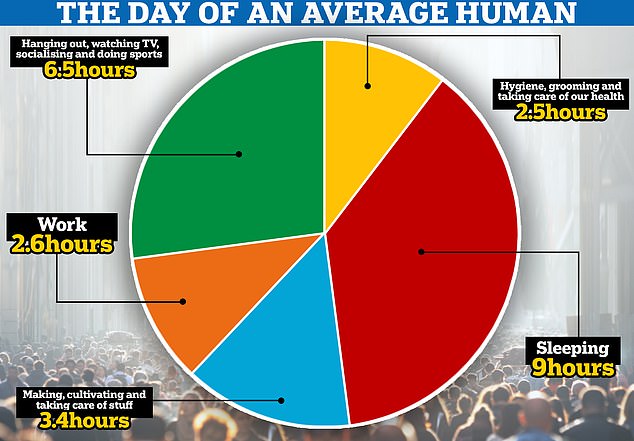
The study also explored how people spend their time in general. Here’s a breakdown of the average daily activities:
- Hanging out, watching TV, socializing and doing sports – 6.5 hours
- Hygiene, grooming and taking care of our health – 2.5 hours
- Sleeping – 9 hours
- Making, cultivating and taking care of stuff – 3.4 hours
- Work – 2.6 hours contributing to the world economy, despite working 41 hours a week
Across all populations, the average daily travel time was 1.3 hours (1 hour and 18 minutes), with a variability of 0.2 hours (12 minutes). In other words, people tend to spend between 66 and 90 minutes a day traveling—regardless of their mode of transport or the distance they cover.
Insights from the Researchers
Eric Galbraith, the study's corresponding author, emphasized one of the most important findings: "The most important finding is that people don't travel less when speed or efficiency increases. Instead, they travel farther."
This insight challenges the assumption that technological advancements in transportation would reduce overall travel time. Instead, it suggests that as transportation becomes faster, people are more inclined to travel longer distances.
The study comes shortly after the same researchers from McGill University revealed what the average person's day looks like. As part of that study, published in 2023, the team analyzed the time-use of people living in 58 countries. They examined everything from mopping up dirty surfaces to processing petroleum.
You may be surprised to learn that meal preparation—covering cooking, dishwashing, and clearing the table—only takes up 55 minutes on average. However, activities like fishing, crop production, and other farming activities take up 52 minutes (0.9 hours), while eating takes around 96 minutes (1.6 hours) every day.
Additional Observations
Showering and taking care of our health takes around 2.5 hours, while throwing out waste takes less than a few minutes. Eric Galbraith, the study's author, explained: "We found that the single largest chunk of time is really focused on humans ourselves, a little more than nine hours. Most of this—about 6.5 hours—is doing things that we enjoy, like hanging out, watching TV, socializing and doing sports."
These findings offer a deeper understanding of how people balance their daily routines, highlighting the importance of leisure and self-care in modern life.
