No, Brussels Didn't Just Ban Cash
Understanding the EU’s New Cash Transaction Rules
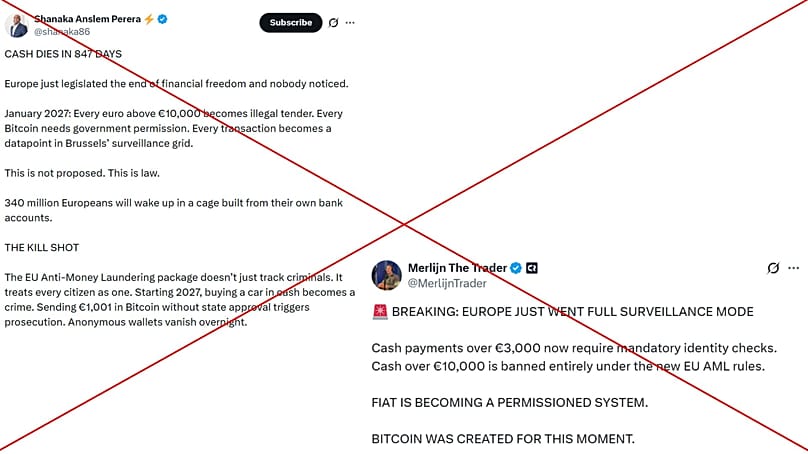
A recent viral post has claimed that "every euro above €10,000 will become illegal tender" and that "cash will soon be contraband" under EU law. However, this is not entirely accurate. While the EU has not banned cash altogether, it is introducing a new set of regulations aimed at curbing money laundering and financial crimes.
The regulation is part of the EU's broader Anti-Money Laundering (AML) package, which includes several key changes to how cash transactions are handled. One of the most notable provisions is the introduction of a bloc-wide cap on cash payments in business transactions. This limit is set at €10,000, meaning businesses will no longer be able to accept cash for amounts exceeding this threshold.
Despite this, private individuals can still conduct transactions using cash without restrictions. For example, if two people are buying or selling something in a non-professional context, they can use any amount of cash. Additionally, individual countries may impose their own lower limits for cash transactions, depending on their national policies.
Will It Be Illegal to Buy a Car in Cash?
One of the more misleading claims circulating online is that buying a car in cash will become a crime under the new rules. In reality, this is not automatically illegal. From 2027, large cash payments to businesses—such as car dealerships—will be capped at €10,000. If you're purchasing a car over this amount from a dealership, they will not be allowed to accept cash. However, you can still pay via bank transfer or credit card.
For private sales, where one individual is selling to another, there are no such restrictions. As long as the transaction is between two private parties and does not involve a business, you can still use cash for any amount. This means that while the new rules will affect certain types of transactions, they do not eliminate the use of cash entirely.
Why Is the EU Introducing These Changes?
The primary goal of the new AML package is to reduce opportunities for money laundering and other forms of financial crime. Currently, the EU has a patchwork of different rules across member states, with some countries like Italy setting a limit of €5,000, while others like Austria have no limit at all.
By establishing a uniform €10,000 cap, the EU aims to make it harder for criminals to use large cash transactions to hide illicit funds. The European Commission argues that this will help close loopholes and improve coordination among member states.
According to the European Commission, large amounts of cash are difficult to trace, making them an attractive tool for criminal activities. Money laundering is a significant global issue, with the United Nations Office on Drugs and Crime estimating that up to €1.87 trillion is laundered annually worldwide.
What’s Next?
The new regulations are set to take effect in July 2027. Alongside the cash limit, the package also includes the establishment of an EU Anti-Money Laundering Authority in Frankfurt. This authority will play a key role in enforcing the new rules and ensuring compliance across member states.
Banks, businesses, and regulators will have a three-year period to adapt their systems and procedures to meet the new requirements. While the policy has faced some criticism, particularly regarding its effectiveness and potential for unintended consequences, the European Commission maintains that it is a necessary step toward a more secure financial system.
Controversies and Misconceptions
Despite the clear intent behind the new rules, there have been concerns about how they are being interpreted online. Some critics argue that the cash limit may not be effective, as criminals could shift to alternative methods like cryptocurrency or cross-border transactions. Others point out that the success of the policy will depend on how smoothly it is implemented across all member states.
This is not the first time that false claims about cash have circulated online. In recent years, similar conspiracy theories have emerged, such as the false narrative that Spain was withdrawing the €50 banknote or that Norway and Sweden were eliminating digital payments altogether. These stories often cause unnecessary panic and confusion among the public.