No More Pennies: US Ends 1-Cent Coin Production
The End of an Era for the US Penny
The humble penny, the smallest unit of the US dollar, has faced a difficult time in recent years. This week marked a significant moment as President Donald Trump’s decision to "cancel" the minting of the coin finally came into effect. The Treasurer of the United States, Brandon Beach, stamped the last penny after 230 years of production by the US Mint on Wednesday during an event held at the minting facility in Philadelphia.
The final pennies are marked with a special Omega stamp and will not be put into circulation. Instead, they will be auctioned off. According to the president, the cost of producing pennies now exceeds their value, leading to this abrupt end to their minting.
Impact on Merchants and Banks
Merchants across the country have experienced a shortage of pennies, making it challenging to provide exact change. Banks are also struggling, as they can no longer order fresh pennies and are rationing their existing stock for customers. One convenience store chain, Sheetz, even offered a promotion where customers could get a free soda by bringing in 100 pennies.
Another retailer highlighted that the lack of pennies could cost them millions due to the need to round down transactions to avoid legal issues. The penny problem began in late summer and is worsening as the country heads into the holiday shopping season. No retailer or bank has called for the penny to remain in circulation.
The Decision and Its Consequences
Trump announced on February 9 that the US would no longer mint pennies. Both the penny and nickel have cost more to produce than they are worth for several years, despite efforts by the US Mint to reduce costs. In 2024, the Mint spent 3.7 cents to make a penny and 13.8 cents to make a nickel.
The Treasury Department placed its last order of copper-zinc planchets — the blank metal disks used to mint coins — in May. Troy Richards, president of Louisiana-based Guaranty Bank & Trust Co., said he had to scramble to have enough pennies on hand for his customers since August. His branches are keeping small amounts of pennies for customers who need to cash checks.
Hoarding and Circulation Issues
The US Mint issued 3.23 billion pennies in 2024, the last full year of production — more than double the output of the country's second-most minted coin, the quarter. However, pennies are rarely recirculated back into the economy after being given as change. Americans tend to store them in jars or use them for decoration, requiring the Mint to produce significant volumes each year.
The government is expected to save $56 million by halting penny minting. Despite the losses on pennies, the Mint remains profitable through the production of other circulating coins and commemorative sets.
Legal and Logistical Challenges
Coin distribution is handled by the Federal Reserve system. Several companies operate coin terminals where banks can withdraw and deposit coins. Roughly a third of these 170 terminals are now closed to both penny deposits and withdrawals, worsening the shortage.
Bank lobbyists say the closures are exacerbating the issue because regions with spare pennies cannot send them to areas running out. A Federal Reserve spokeswoman stated that coin distribution locations accepting penny deposits and fulfilling orders will vary over time as inventory is depleted.
Legal Minefield for Retailers
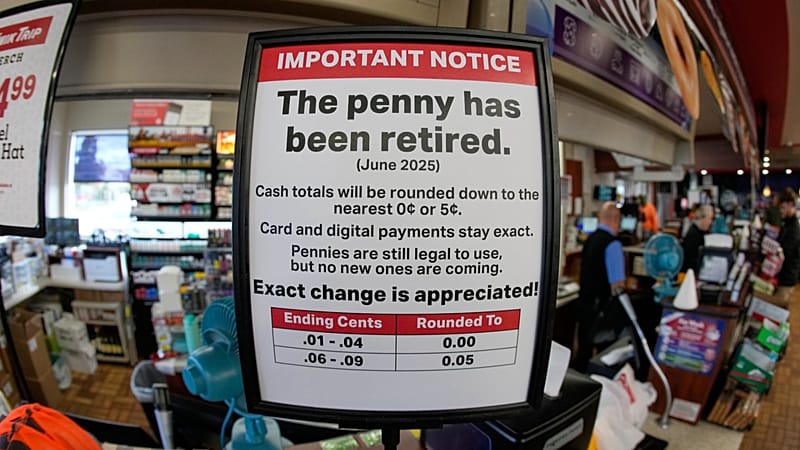
The lack of pennies has created a legal minefield for stores and retailers. In some states and cities, rounding up a transaction to the nearest nickel or dime is illegal. To avoid lawsuits, retailers are rounding down, which adds up over tens of thousands of transactions. A spokesman for Kwik Trip, a Midwest convenience store chain, said the company rounds down every cash transaction to the nearest nickel, potentially costing $3 million this year.
Some retailers are asking customers to donate their change to local charities to avoid using pennies altogether. A bill currently pending in Congress, the Common Cents Act, calls for cash transactions to be rounded to the nearest nickel, but it is widely supported by businesses.
International Examples
The United States is not the first country to phase out small-denomination coins. Canada eliminated its one-cent coin in 2012, transitioning away from one-cent cash transactions starting in 2013. The UK’s decimalisation took much of the 1960s and early 1970s. In contrast, the US removed the penny abruptly without any action by Congress or regulatory guidance for banks, retailers, or states.
A Brief History of the US Penny
The penny was one of the first coins made by the US Mint in 1792. Congress discontinued the half cent in 1857 but kept the penny, making it smaller to save on copper. Today, the penny is made with 97.5% zinc with copper plating.
There are an estimated 250 billion pennies still in circulation in the US, according to the American Bankers Association. While the last pressed pennies will not disappear quickly, their circulation will slow. Pennies remain legal tender and will continue to be worth one cent.
Defenders of the coin argue that the cost to make pennies is modest compared to other denominations. A nickel costs nearly 14 cents to mint; each dime costs nearly 6 cents; and a quarter costs nearly 15 cents.
