Simple math puzzle divides people - can you solve it in 30 seconds?
A Deceptively Simple Math Problem That Stumped the Internet
A seemingly straightforward math problem has recently gone viral on social media, leaving many users confused and questioning their basic arithmetic skills. The equation in question is 20 - 4 X 3 + 12 = 20. At first glance, it appears easy to solve, but the challenge lies in applying the correct order of operations.
The key to solving this problem is understanding the acronym PEMDAS, which stands for Parentheses, Exponents, Multiplication and Division (from left to right), and Addition and Subtraction (from left to right). This rule ensures that mathematical expressions are evaluated consistently and accurately.
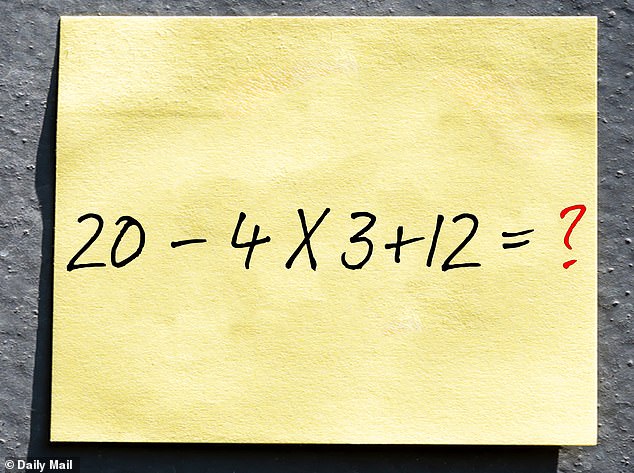
Despite the clear guidelines provided by PEMDAS, many people have struggled to arrive at the correct answer. Some common incorrect responses include 60 and -4, but the actual solution is 20. Let’s break down how to reach this result step by step.
First, you need to handle the multiplication part of the equation. In this case, 4 multiplied by 3 equals 12. However, since the number is negative, it becomes -12. This simplifies the original equation to 20 - 12 + 12.
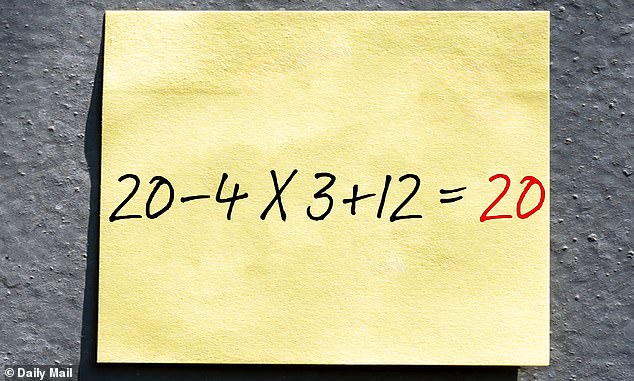
Next, you focus on the addition and subtraction. According to PEMDAS, these operations should be performed from left to right. So, subtracting 12 from 20 gives you 8. Then, adding 12 to 8 results in the final answer of 20.
Another way to approach this is by combining the -12 and +12 first. These two numbers cancel each other out, resulting in 0. Adding 0 to 20 still gives you the correct answer of 20.
This problem highlights the importance of following the proper order of operations, even in what seems like a simple equation. It also serves as a reminder that sometimes, the most straightforward problems can be the trickiest when it comes to execution.
Common Mistakes and Why They Happen
- Ignoring the order of operations: Many people tend to solve equations from left to right without considering the precedence of multiplication over addition and subtraction.
- Misinterpreting negative numbers: The presence of a negative sign can confuse some individuals, leading to errors in calculations.
- Assuming addition always comes before subtraction: While addition and subtraction are on the same level in PEMDAS, they must be solved in the order they appear.
Tips for Solving Similar Problems
- Always start with parentheses and exponents if they are present.
- Handle multiplication and division from left to right.
- Proceed with addition and subtraction in the same manner, ensuring you follow the sequence as written.
This math problem may have left many scratching their heads, but with a clear understanding of PEMDAS, it becomes much simpler. Whether you’re a student revisiting basic math or an adult looking to sharpen your skills, this equation serves as a valuable exercise in logical thinking and problem-solving.
